Nike Style Code Lookup: Find Any Shoe by Its Code
Every pair of Nike sneakers carries a short code that tells you exactly what it is. Search that code and you'll usually land on the exact model and colorway within seconds. That's all a Nike style code lookup is: using the code on the tag or box to identify a shoe, check a listing, or start a legit check.
The code goes by many names: SKU, product code, style number, model number. People searching for a "Nike serial number check" or a "Nike product code search" are usually after the same thing. This guide explains what the code means, where to find it, how to look it up, and what it can't tell you.
If you'd rather skip the typing, our Nike shoe identifier can name a pair from a photo.
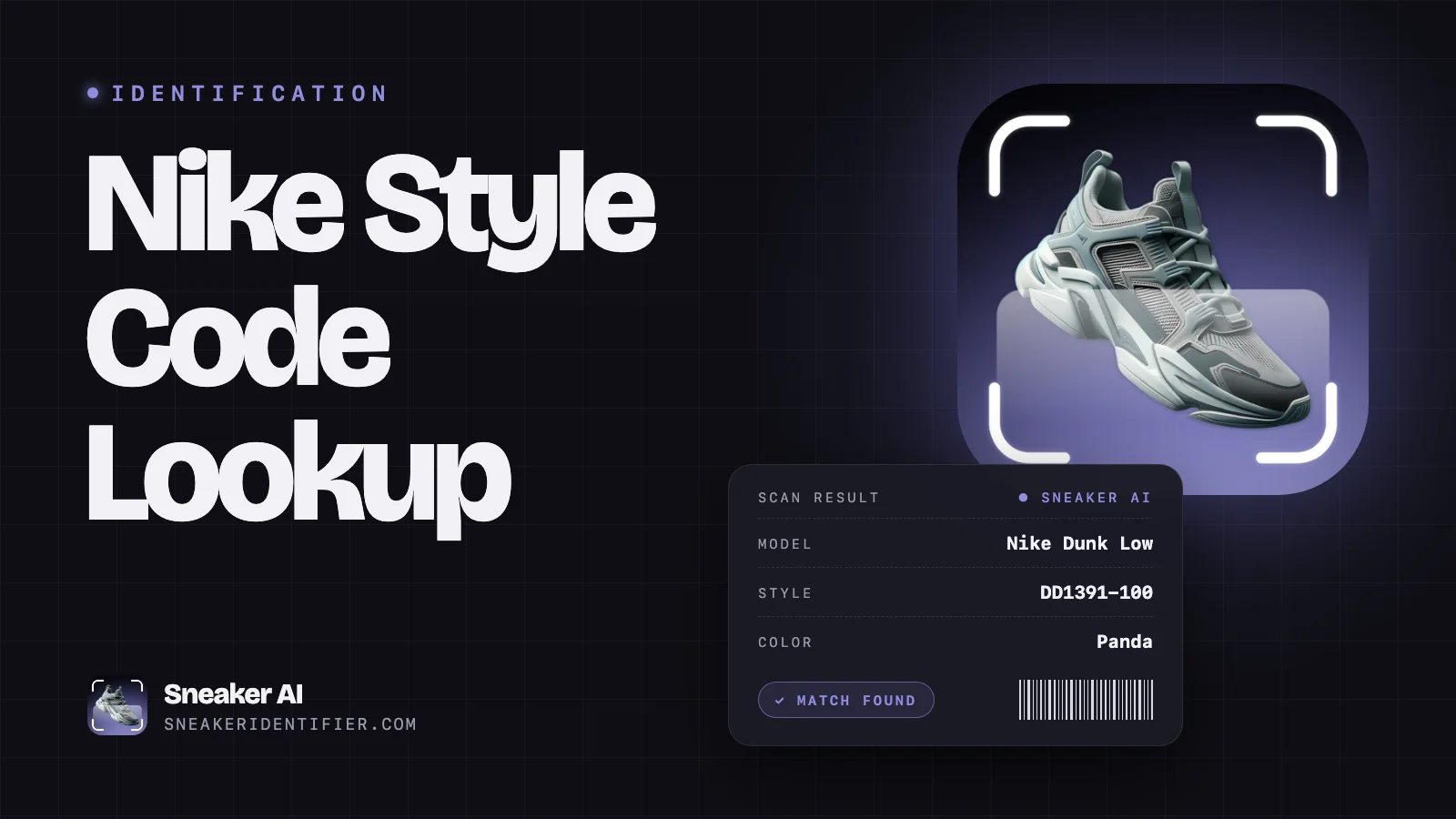
Quick answer: A Nike style code (also called a style-color code, SKU, or product code) looks like DD1391-100. The first part identifies the model and design, and the three digits after the hyphen identify the colorway. Find it on the size tag or box label, then search it in quotes on Google, Nike's site, or a resale marketplace. Nike shoes have no unique serial numbers, and a matching code or UPC confirms what a pair claims to be, not that it's authentic.
What a Nike Style Code Is
A Nike style code has two parts separated by a hyphen:
- The style number identifies the model and design. Newer codes use two letters followed by four digits, such as DD1391. Older codes are six digits, such as 555088.
- The color code is three digits that identify the colorway, such as 100.
Together, the full style-color code points to one specific product. DD1391-100 is the Nike Dunk Low Retro in White/Black, the colorway everyone calls "Panda."
A few examples show how it works:
| Style-color code | Shoe |
|---|---|
| DD1391-100 | Nike Dunk Low Retro "Panda" (men's) |
| DD1503-101 | Nike Dunk Low "Panda" (women's) |
| CW2288-111 | Nike Air Force 1 '07 White |
| 315122-111 | Nike Air Force 1 '07 White (older code) |
| 555088-101 | Air Jordan 1 Retro High OG "Chicago" (2015) |
| CU1110-010 | Air Jordan 4 Retro "Black Cat" (2020) |
Note that men's, women's, and kids' versions of a colorway often have different style numbers, and a shoe can be reissued under a new code, like the white Air Force 1 '07 above. That explains many "right shoe, different code" results.
Style Code, SKU, Model Number: Are They the Same?
In sneaker circles, mostly yes. "Style" and "style-color" are Nike's terms, and Nike's product pages list the code in the details as "Style." Many retailers and resale platforms call it the SKU. A store's internal SKU sometimes adds size data, but when sneakerheads say SKU, they mean the style-color code. "Product code" and "model number" are casual names for the same thing. So a "Nike SKU lookup," a "shoe model number lookup," and a "Nike product code search" all lead to the same process.
Where to Find the Style Code
The size tag inside the shoe. On most Nike and Jordan sneakers, it's sewn to the back of the tongue, and on some models it's on the inside wall near the heel. The code sits below the size conversions. Our Nike shoe tag guide explains every line.
The box label. The sticker on the end of the box repeats the style-color code along with the model name, size, colorway, and UPC barcode. If the tag has faded, the original box is your backup.
Product pages, receipts, and listings. Nike's product pages show the code in the details, and many retailers and resale sites list it too. Some retailers print it on receipts and order emails. If a resale listing doesn't include it, ask the seller for a clear photo of the size tag. A seller who won't share one is telling you something.
How to Look Up a Nike Style Code, Step by Step
Step 1: Copy the Full Code Exactly
Write down the complete code, including the hyphen and color code: DD1391-100, not just DD1391. Watch for characters that are easy to confuse on a small tag, like the letter O and the number 0. On modern Nike codes, only the first two characters are letters.
Step 2: Search It in Quotes
Put the full code in quotation marks in a search engine: "DD1391-100". The quotes limit results to pages containing that exact code. Switch to image results to compare photos with your pair. If the full code returns nothing, search the style number alone (DD1391) to see the model and its other colorways, which helps you spot a typo.
Step 3: Check Nike's Site
Search Nike's website or app for the code. Current products usually come up, with the "Style" line confirming the match. Older styles often won't, which is normal.
Step 4: Check Resale Marketplaces
Resale platforms such as StockX, GOAT, and eBay organize products by style code, which makes them especially useful for older pairs and collaborations.
Step 5: Let Sneaker AI Read the Shoe
If the tag is worn off, or you just want the answer faster, photograph the shoe or the tag with Sneaker AI. The app identifies the model, colorway, and style code from a photo, recognizes 500+ brands, and shows a reference resale price from recent marketplace sales. See what shoe is this? for how the photo search works.
Step 6: Confirm the Result Matches the Pair
Compare the result with the actual shoe: model, colorway, materials, and details like heel branding. If the code says "Panda Dunk" and you're holding a gray suede shoe, the code was misread, the tag belongs to another pair, or the shoe isn't what it claims to be.
What the Color Code Tells You
The three-digit color code separates colorways of the same model. Every colorway of a style shares the style number and gets its own ending, so other DD1391 colorways are the same Dunk Low design in different colors.
The first digit tends to hint at the main color: 0 for black, 1 for white, 6 for red, and so on. This is a widely observed pattern, not an official Nike rule. The Panda Dunk (100) and the Black Cat Jordan 4 (010) follow it, but plenty of shoes don't. Our Nike shoe tag guide has the full table.
A few practical notes:
- The color code doesn't change with size. Every size of DD1391-100 shares it. Size lives in the UPC.
- Custom pairs are different. Nike By You customs commonly carry a color code in the 900s that won't return a retail colorway. That's expected on a custom, not on a pair sold as a general release.
- Don't guess a colorway from the code alone. Use it to confirm a match.
"Nike Serial Number Check": Why It's the Wrong Search
Many people search for a way to check a Nike serial number, expecting something like a phone's IMEI: a unique number a database can confirm. Nike sneakers don't work that way.
There is no unique serial number on a pair of Nike shoes. The size tag carries:
- The style-color code, shared by every pair of that model and colorway
- The size, in several regional systems
- A production date range, the window when that batch was made
- The country of manufacture
- Internal production and factory codes that Nike uses for its own tracking
- A UPC barcode, shared by every pair of the same style, color, and size
None of these identify one individual pair, and Nike doesn't offer a public tool that checks whether a specific pair is genuine. So a "shoe serial number check" can really only look up the style code or UPC. That identifies the product, but it doesn't authenticate the pair, because counterfeiters print real codes on fake shoes.
What a UPC Is, and What "UPC Verified" Means
A UPC (Universal Product Code) is the 12-digit barcode number on the size tag and box label. It identifies one style, colorway, and size: every men's size 10 Panda Dunk shares one UPC, and a size 10.5 has another.
You'll sometimes see resale listings described as "UPC verified." There's no single industry standard behind the phrase, but it usually means the barcode on the box label (or tag) was scanned or matched against the product's catalog UPC and came back as the listed style, colorway, and size.
That's worth something: it suggests the label matches the product being advertised, in the size being sold. It does not prove the shoes are authentic. Counterfeiters copy UPCs from real pairs, so a fake box label can scan perfectly. Treat "UPC verified" as a consistency check, not a legit check.
How to Use the Style Code in a Legit Check
The code can't prove a pair is real, but mismatches are some of the most useful red flags you'll find. Here's what to compare:
- Tag vs. colorway. Does the code on the tag return the shoe you're holding? A code for a different colorway, a different model, or nothing at all is a serious warning sign.
- Tag vs. box label. The style-color code, size, and UPC on the box should match the tag exactly. Boxes do get swapped, so a mismatch isn't automatically a fake, but it needs an explanation.
- Left tag vs. right tag. Both tags should show the same style-color code and size, and production dates are usually the same or very close. Different codes can mean two pairs were mixed, or that the tags were printed carelessly on a fake.
- Code vs. release history. Production dates should make sense for the release. A tag dated long before that colorway existed is a problem. Restocks can carry later dates.
- Print quality. Fuzzy, crooked, or oddly spaced printing is a common fake tell, though faded print on a worn pair means very little.
No single check settles it. Authentic pairs have factory variation, and a good fake usually gets the code right. Once the code tells you what the shoe should be, compare the pair with verified photos of that exact release. Guides like how to spot fake Nike Dunks show what to check next.
For a verdict, the sneaker authenticator in Sneaker AI starts with an AI scan that flags common replica tells. For valuable pairs, the Expert Legit Check sends your photos to two human authenticators, who return a verdict in under 5 minutes, with a shareable digital Certificate of Authenticity if the pair passes.
Jordan, Adidas, and New Balance Codes
Jordan Brand uses Nike's format exactly. The Air Jordan 4 "Military Black" is DH6927-111, so everything in this guide applies, and the Jordan authenticator covers Jordans specifically.
Adidas calls its code the article number. It's usually six characters, such as B75806 (the white Samba OG with black stripes and a gum sole) or CP9654 (the Yeezy Boost 350 V2 "Zebra"). Unlike Nike, Adidas doesn't split the code into model and color parts: each article number stands for one colorway. Find it on the size tag or box label and search it the same way, or use the Adidas identifier.
New Balance combines model and color into one code, such as BB550WT1 for the White/Green 550. Our New Balance 550 legit check explains how those codes are built.
When the Code Doesn't Return Anything
A code that turns up nothing isn't always a fake. Rule out the usual explanations first:
- A typo. Recheck O vs. 0, I vs. 1, and the color code.
- A worn tag. Use the box label, or photograph the shoe and let an identifier match it visually.
- An older pair. Search the style number alone, or add the model name.
- Customs, samples, and player exclusives. These may have no public retail listing.
- Regional releases. Some colorways show up mostly on regional retail sites.
If none of these explain it, treat a code with no trace anywhere as a red flag, especially on a popular model like a Dunk, Air Force 1, or Jordan 1.
Frequently Asked Questions About Nike Style Codes
How do I look up a Nike shoe by its style code?
Find the full style-color code on the size tag or box label (for example, DD1391-100), then search it in quotes on Google, Nike's site, or a resale marketplace such as StockX, GOAT, or eBay. The results should show the exact model and colorway.
Is the Nike style code the same as the SKU?
In practice, yes. Nike calls it the style or style-color code, while many retailers and resale platforms label the same code as the SKU.
Can I check a Nike serial number to see if my shoes are real?
No. Nike shoes don't have unique serial numbers, and Nike doesn't offer a public tool for checking whether a specific pair is genuine. The codes on the tag identify the product, not the individual pair, and counterfeiters copy them.
What does "UPC verified" mean on sneakers?
It usually means the barcode on the box label or tag was matched against the product's catalog UPC and returned the listed style, colorway, and size. It confirms the label matches the listing, not that the shoes are authentic.
Do fake Nikes have real style codes?
Usually. Most counterfeits copy the code from a real pair, so a correct code proves nothing on its own. A code that returns a different shoe, or nothing at all, is a much stronger signal.
Can I find a shoe's style code from a photo?
Yes. Identifier apps like Sneaker AI can read the model, colorway, and style code from a photo of the shoe or its tag, which helps when the tag is faded or you only have a listing photo.
The style code turns "some white and black Dunks" into one exact product. Look it up, make sure the tag, box, and shoe agree, then move on to the shoe itself. That's where a legit check is won or lost.
No Code? Use a Photo
Snap the shoe or its tag and Sneaker AI returns the model, colorway and style code, with a reference resale price. Add an Expert Legit Check for a verdict from two authenticators.