Jordan 1 High vs. Mid vs. Low: Every Difference Explained
The Air Jordan 1 comes in three main heights, and the Jordan 1 High vs. Mid vs. Low question trips up new buyers constantly. At a glance, they share the same famous design: the big Swoosh, the color-blocked leather panels, the basketball DNA. The differences affect how they look on foot, how much they cost, how easy they are to buy, and how well they hold their value.
This guide breaks down every difference that matters, from the quick visual tells to fit, price, resale, and which version suits you.
Quick answer: The Jordan 1 High is the original 1985 silhouette, with the tallest collar, a "Nike Air" tongue tag on Retro High OG versions, and the strongest resale value. The Jordan 1 Mid sits slightly lower, uses a Jumpman tongue tag, has one fewer lace hole per side, and is a more affordable, widely available general release. The Jordan 1 Low sits below the ankle and comes in standard (Jumpman branding) and Low OG (Nike Air and Wings branding) versions.
A Little History
Designed by Peter Moore, the Air Jordan 1 debuted in 1985 as Michael Jordan's first signature shoe, and the high-top was the original. Low-top versions have existed since the 1980s as well. The Mid is a later addition to the lineup, created to offer the Jordan 1 look in more colorways at a lower price.
Today, all three are made in a constant stream of colorways. The High carries the heritage, the Mid offers availability, and the Low has grown into a summer staple and a collaboration favorite.
The Quick Comparison
| Jordan 1 High | Jordan 1 Mid | Jordan 1 Low | |
|---|---|---|---|
| Collar height | Tallest, above the ankle | A little lower than the High | Below the ankle |
| Lace holes per side | 9 | 8 | Fewer (low-top lacing) |
| Tongue tag | "Nike Air" on Retro High OG versions | Jumpman | Jumpman (standard); "Nike Air" on Low OG |
| Collar and heel logos | Wings logo on the ankle collar | Usually a Wings logo on the ankle collar | Jumpman on the heel (standard); Wings logo on the heel (Low OG) |
| How it's released | Limited OG drops plus some wider releases | Mostly general releases | General releases plus limited Low OG drops |
| Retail price | Highest | Middle | Lowest (Low OGs cost more) |
| Resale strength | Strongest | Usually at or below retail | Low OGs and collaborations can be strong |
| Best for | Collectors and statement outfits | Everyday wear on a budget | Warm weather and easy styling |
How to Tell a Jordan 1 High From a Mid
This is the comparison that causes the most confusion, because Highs and Mids look so similar in photos. Check these four details:
1. Count the Lace Holes
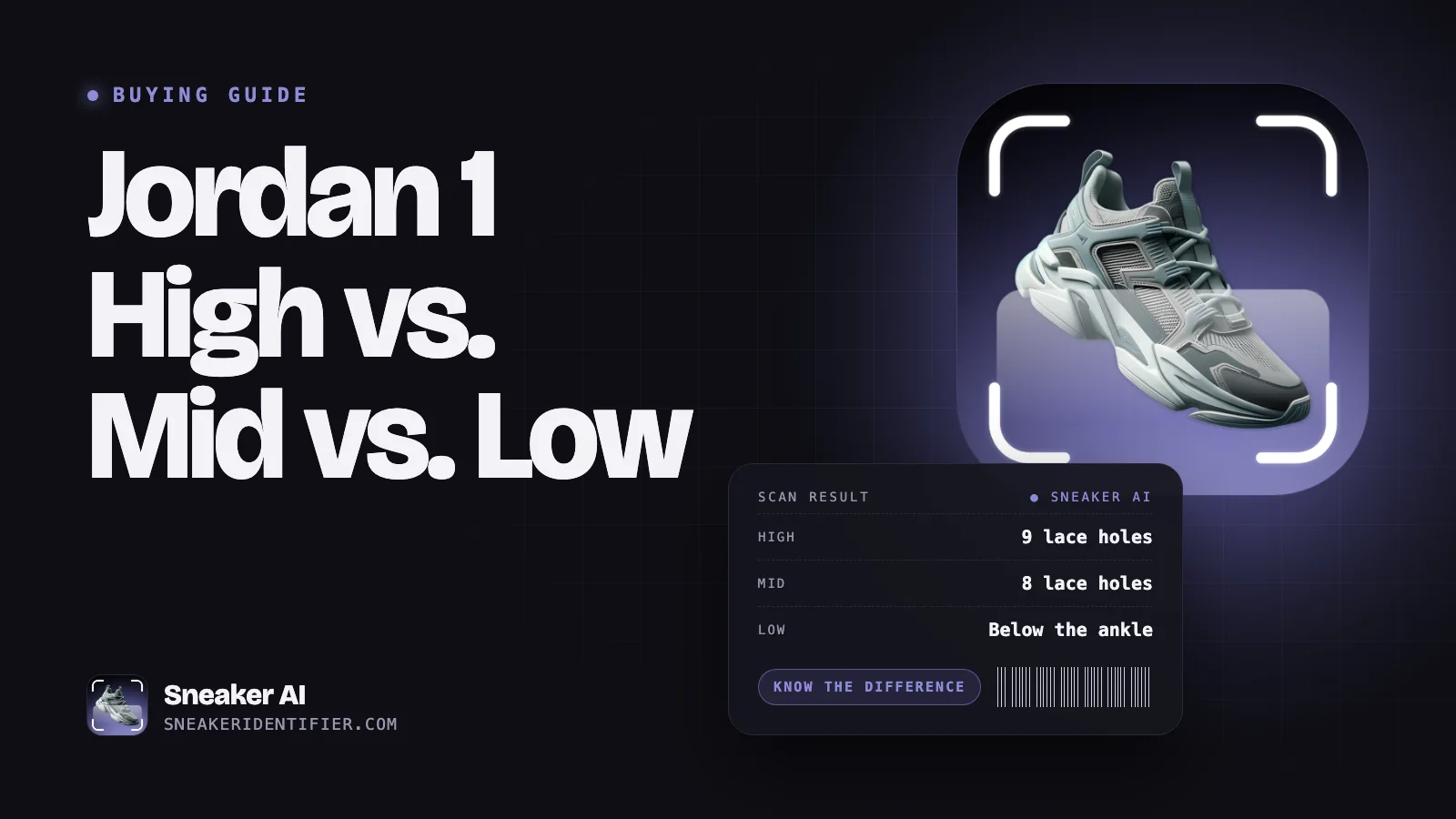
The simplest tell: Highs have nine lace holes per side, while Mids have eight. Count from the toe to the collar.
2. Check the Tongue Tag
Air Jordan 1 Retro High OG releases carry a "Nike Air" tongue tag, a nod to the 1985 original. Mids use a Jumpman tongue tag. Some non-OG Highs also use a Jumpman tag, so combine this check with the lace count.
3. Compare the Collar Height
The Mid's collar is cut a little lower than the High's. Side by side, the High looks taller and more structured around the ankle. In a single photo, look at how much space sits between the top of the Swoosh and the top of the collar. On a High, there's noticeably more upper above the Swoosh.
4. Look at Materials and Shape
High OG releases typically use the most premium leathers in the lineup and an OG-inspired shape. Mids often use more coated or synthetic leathers and a slightly different shape. This varies by release, so treat it as a supporting clue.
How to Tell a Standard Jordan 1 Low From a Low OG
The Low also comes in two main versions:
- Air Jordan 1 Low (standard): Jumpman logo on the tongue and the heel. It's widely available and usually the most affordable Jordan 1.
- Air Jordan 1 Low OG: A "Nike Air" tongue tag and a Wings logo on the heel, inspired by vintage details. It's released in more limited drops and costs a bit more.
Many of the most hyped Jordan 1 collaborations have been Lows, so the Low is far more than a budget option. The right Low OG can be one of the most valuable Jordan 1s on the market.
Fit and Sizing
All three versions generally fit true to size for most people.
- Highs feel the most structured. Stiff new leather can take a few wears to break in, especially around the collar.
- Mids fit very similarly to Highs, with a slightly less restrictive collar.
- Lows feel the least restrictive and are the easiest to slip on and off.
If you have wide feet, try a pair on before buying, since the Jordan 1's toe box is fairly narrow. For brand-by-brand fit notes, see our sneaker size guide.
Price and Availability
- Highs: Retro High OG releases are usually the most expensive Jordan 1s at retail, and popular colorways often sell out quickly in limited drops.
- Mids: The most widely available Jordan 1, released in a huge range of colorways and usually easy to find at retail.
- Lows: Standard Lows are widely available and affordable. Low OGs release in more limited drops at a higher price.
Resale Value
If you care about value, the version matters a lot:
- High OGs have historically held value best, especially the original 1985 colorways such as "Chicago," "Bred," and "Royal," along with collaborations.
- Mids rarely resell above retail. There are exceptions, but most Mids are bought to wear.
- Low OGs and collaborations can command strong resale, especially high-profile collabs.
Want to price a pair you already own? Our guide on how much your sneakers are worth walks through it step by step.
What About the "Mids Aren't Cool" Debate?
Sneaker culture has long joked about Jordan 1 Mids, mostly because collectors chasing High OGs saw Mids as the "lesser" version. In practice, Mids are among the most worn sneakers in the world. They offer the classic Jordan 1 look in more colorways, at a lower price, and with far less hassle to buy.
If you're buying to wear and like the look, a Mid is a perfectly good choice. If you're collecting or care about resale, Highs and Low OGs are the stronger picks.
Which Jordan 1 Should You Buy?
- Choose the High if you want the original silhouette, plan to collect, care about resale, or want a statement shoe that pairs well with straight-leg pants and shorts.
- Choose the Mid if you want the Jordan 1 look for everyday wear, at a lower price, in a colorway you can actually find at retail.
- Choose the Low if you want an easygoing, warm-weather shoe that works with almost anything. Pick a Low OG for vintage details or a better shot at resale value.
A Note on Fakes
All three versions are counterfeited, and Highs and Low OGs attract the most effort because they resell for the most. Watch for sellers listing Mids as Highs (count those lace holes) and for grade school pairs listed as adult sizes. Our Jordan 1 legit check guide covers the authentication details, and our guide to Jordan 1 and Dunk colorway nicknames helps you confirm you're looking at the release you think you are.
Frequently Asked Questions About Jordan 1 Heights
Is a Jordan 1 Mid a real Jordan?
Yes. The Air Jordan 1 Mid is an official Jordan Brand model. It's a different version of the Jordan 1 with a slightly lower collar, a Jumpman tongue tag, and usually a lower price than the High.
How can I tell if my Jordan 1s are Mids or Highs?
Count the lace holes: Highs have nine per side, Mids have eight. Then check the tongue tag. Retro High OG versions say "Nike Air," while Mids carry a Jumpman.
Which is more comfortable: Jordan 1 High, Mid, or Low?
Comfort is similar across all three, since they share a similar sole with an encapsulated Air unit in the heel. Lows feel the least restrictive around the ankle. Highs feel the most structured and can take longer to break in.
Do Jordan 1 Lows run small?
Most people wear their normal size in Jordan 1 Lows. The toe box is fairly narrow, so wide-footed wearers sometimes go up half a size.
Why are Jordan 1 Highs more expensive than Mids?
Retro High OG releases typically use more premium materials and OG-specific details, and they're released in more limited quantities. Mids are produced in larger numbers as general releases.
What does "OG" mean on a Jordan 1?
"OG" indicates a version built with details inspired by the original 1985 shoe, such as the "Nike Air" tongue tag and an OG-style shape. It applies to both Retro High OG and Low OG releases.
High, Mid, or Low, they're all the same legendary design at different heights and price points. Pick the High for heritage and value, the Mid for easy everyday wear, and the Low for laid-back style. And if you're weighing the Low against its closest rival, see our breakdown of the Nike Dunk Low vs. the Jordan 1 Low.
High, Mid, or Low? Know Exactly What You Have
Scan any Jordan 1 to identify the exact model, colorway, and style code in seconds — then check its live resale value or run an instant legit check.