Beginner's Guide to Sneaker Collecting (2026): Build Your First Rotation
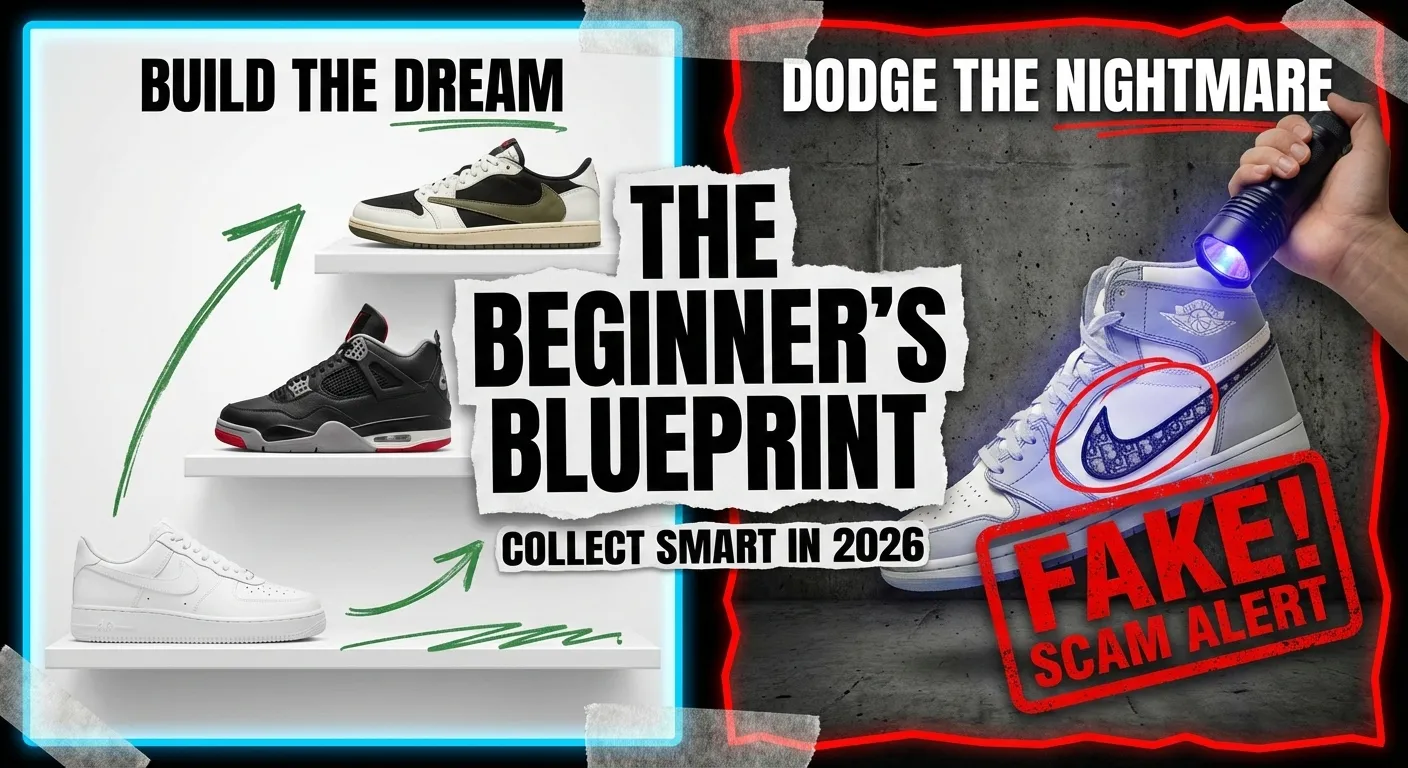
Sneaker collecting for beginners in 2026 is simultaneously the best and most dangerous time to start.
The culture has never been more accessible — every major brand has a direct-to-consumer app, the resale market is liquid and global, and there is a community of collectors at every level willing to share knowledge. But with that accessibility comes a sophisticated counterfeit ecosystem designed to exploit anyone who hasn't learned the basics yet.
This guide gives you the full foundation for sneaker collecting as a beginner: the vocabulary you need, the silhouettes to start with, where to buy safely, how to authenticate from day one, and how to protect the resale value of everything you acquire.
The Sneaker Collecting Glossary: Terms Every Beginner Needs
Before you spend a dollar, learn the language. These are the terms you will encounter in every marketplace, forum, and Discord server.
DS — Deadstock Brand new, unworn, with original packaging. The highest condition grade and the most valuable on the secondary market.
VNDS — Very Near Deadstock Tried on once or worn briefly indoors. Practically new, but not DS. Carries a slight price discount from DS depending on the seller.
OG — Original Refers to the original colorway of a silhouette when it was first released, as opposed to a retro reissue or a new colorway using the same shoe.
GS — Grade School A sizing designation for smaller sizes (typically US 3.5–7) originally designed for children but commonly worn by adults with smaller feet. GS pairs can have slightly different materials or quality control standards than adult pairs.
Collab — Collaboration A limited-edition release produced in partnership between a sneaker brand and a designer, artist, celebrity, or fashion house. Collabs almost always command significant resale premiums.
Retail The original manufacturer's suggested retail price (MSRP). Buying at retail is the goal — it is the baseline price before market forces apply any premium.
Resale Purchasing a shoe on the secondary market above (or occasionally below) retail price. Most high-demand shoes sell at resale within minutes of dropping at retail.
Grail A shoe you consider the ultimate target — the one pair you want more than anything else. Personal, not market-defined.
Legit Check The process of verifying that a sneaker is authentic rather than a replica. Every purchase from a non-retail source warrants a legit check.
Cop To successfully purchase a shoe, usually used in the context of retail releases: "Did you cop the new Dunk?"
Heat High-desirability shoes — the pairs that are heavily sought-after at any given time.
Rotation Your active collection of shoes you actually wear, as distinct from display pairs or investment pairs kept in storage.
How to Start a Sneaker Collection: Your First Three Pairs
The single most common mistake in beginner sneaker collecting is chasing hype immediately. A $2,000 hype shoe as your first purchase is a high-risk introduction to a market you don't yet understand. Start with silhouettes that are versatile, well-documented, and easy to authenticate.
The Lifestyle Foundation: Nike Dunk Low or Air Force 1
The Nike Dunk Low and Air Force 1 are the most documented, authenticated, and widely resold sneakers in the world. That documentation is a feature for beginners — there are thousands of authentic reference photos available online, making it straightforward to learn what a real pair looks like. Start in a neutral colorway (white, black, or a classic two-tone) that pairs with everything.
Retail: $100–$120. Most colorways are accessible at retail through the SNKRS app, Nike.com, or Foot Locker.
The Comfort Pillar: New Balance 1906R or 574
New Balance has established itself as the cultural benchmark for "cool yet comfortable" collecting in 2026. The 1906R gives you the tech-runner aesthetic with genuine cushioning technology. The 574 is simpler and more affordable — an ideal first New Balance purchase for those who want to understand the brand before committing to a premium silhouette.
Retail: $90–$160 depending on model. Available directly from newbalance.com.
The Heritage Statement: Adidas Gazelle Bold or Asics Gel-1130
For collectors interested in the platform or retro-runner aesthetic, either of these silhouettes provides a strong foundation. The Gazelle Bold's platform sole and heritage Adidas branding make it immediately recognizable. The Gel-1130 gives you entry into the Asics lifestyle segment that has exploded in cultural relevance since 2024.
Retail: $110–$130. Widely available at retail.
Understanding Sneaker Pricing: Retail vs. Resale
One of the most important skills in sneaker collecting is understanding whether a price makes sense before you pay it.
How Resale Premiums Form
Resale premiums exist when demand exceeds the supply available at retail. Nike's SNKRS app releases, for example, are deliberately limited — a shoe that sells out in 90 seconds at $120 will immediately appear on StockX and GOAT at $200–$600 depending on demand.
How to Check If a Price Is Fair
Before any secondary market purchase, check the "Last Sale" prices on StockX or GOAT for your exact size and colorway. These platforms publish completed transaction prices — not asking prices — giving you a real market benchmark. If a peer-to-peer seller (eBay, Facebook Marketplace) is pricing at or below the StockX last sale, the price may be fair or even a deal. If they're pricing significantly above it with no explanation, they're either uninformed or testing your inexperience.
When Below-Retail Is a Red Flag
A price significantly below the verified market rate almost always signals one of two things: the seller needs to move the shoe urgently (less common) or the shoe is a replica (far more common). Trust the market. If StockX shows $220 for your size and a Facebook seller wants $130, that gap is your first authentication signal.
Where to Buy Sneakers as a Beginner
Retail (Lowest Risk)
- SNKRS app — Nike's official app for limited releases. Requires registration and sometimes a draw entry. Free to use.
- New Balance app — Direct access to NB releases and general stock.
- Adidas.com / CONFIRMED app — For Adidas and Yeezy releases.
- Foot Locker, JD Sports, Size? — Brick-and-mortar and online retail with buyer protection.
Always try retail first. Retail means you know the shoe is authentic, you have a receipt, and you pay no premium.
Authenticated Resale Platforms (Medium Risk)
- StockX — Every shoe is verified by StockX before delivery. Prices are transparent based on actual sales data.
- GOAT — Similar verification model to StockX. Strong selection of both new and used pairs.
- eBay with Authenticity Guarantee — For shoes above the qualifying price threshold, eBay routes the pair through third-party authentication before it ships to you.
Peer-to-Peer (Highest Risk, Best Prices)
- Facebook Marketplace, Depop, Instagram — No platform authentication. Best prices exist here, but so do the most scams. Always authenticate before payment. See our guide on how to buy sneakers safely on eBay and Facebook Marketplace for the full process.
How to Authenticate Sneakers as a Beginner
Authentication is not optional — it is the core discipline of sneaker collecting. Even if you're buying from a friend, even if the seller has positive reviews, even if the packaging looks perfect.
Don't Rely on Vouches
A "vouch" is a screenshot of someone else saying a seller is legitimate. In 2026, these are trivially easy to fabricate. Any seller who leads with vouches instead of offering photos and an authentication check is giving you a social pressure signal, not a guarantee.
The SKU Check
Every authentic sneaker carries a style code on the box label and the interior size tag. These codes must match each other exactly. Use a shoe identifier app to cross-reference the code against official brand databases — it returns the correct model, colorway, and release year. A mismatch is an immediate disqualifier.
AI Authentication
A mobile sneaker scanner app analyzes photos of your shoe against verified authentic pairs — checking stitching density, logo geometry, color values, and material texture at a level the human eye cannot match. For beginners who haven't yet built up reference knowledge, this is the most important tool available.
The Certificate of Authenticity
A digital Certificate of Authenticity from a professional shoe authenticator service is the most powerful verification document in the market. Unlike paper receipts (which are easily forged), a digital certificate is linked to a verifiable record. It also dramatically increases resale value — buyers trust pre-certified pairs and are willing to pay a premium for the certainty.
For a complete walkthrough of the authentication process, see our full sneaker authentication guide.
How to Store and Care for Your Sneakers
Proper storage is the difference between a pair that holds its value and one that yellows, creases, and falls apart on a shelf.
The Basics
- Keep the original box. A pair without its box loses 15–25% of resale value immediately. Store boxes away from direct sunlight and humidity.
- Use silica gel packets. Place one or two silica gel packets inside each shoe when storing. They absorb moisture and slow the breakdown of adhesives and foam.
- Avoid direct sunlight. UV exposure yellows midsoles and fades materials — particularly suede and mesh. Store in a cool, dark space or use UV-blocking display boxes.
- Rotate your wears. Foam midsoles need time to decompress between wears. Rotating through three or more pairs extends the life of each significantly.
Cleaning
For light cleaning, a soft-bristle brush with mild soap and water handles most materials safely. For suede, use a suede brush and eraser — never water directly on raw suede. For white midsoles, a Magic Eraser works effectively on rubber without damaging the foam.
How to Protect Resale Value From Day One
Sneakers are one of the few consumer goods that can appreciate in value while being worn — but only if you manage them correctly.
Condition is Everything
Resale platforms grade condition: DS, VNDS, Good, Fair. Even a single crease in the toe box can move a pair from DS to VNDS pricing. Use crease protectors when wearing high-value pairs and consider display-only status for investment-tier shoes.
Documentation Adds Value
Keep the original box, any hang tags, extra laces, and any retail receipts you have. A fully documented pair with box, receipt, and Certificate of Authenticity is the easiest sale on any platform — buyers pay a premium for certainty.
Get Certified Before You Sell
Having a professional sneaker authentication certificate before listing your pair removes the biggest friction point in any secondhand sale: the buyer's doubt. Pre-certified pairs sell faster and at higher prices than identical pairs without documentation.
The Beginner Sneaker Collecting Checklist
Before Your First Purchase
- [ ] Learn the market price — check StockX or GOAT last sale for your size
- [ ] Try retail first — SNKRS, brand apps, and authorized retailers
- [ ] If buying resale, use an authenticated platform (StockX, GOAT, eBay AG)
- [ ] For peer-to-peer: request full photo set before agreeing to purchase
At Every Purchase
- [ ] Verify SKU on box label matches interior size tag
- [ ] Run AI shoe authenticator on photos before payment
- [ ] Use PayPal Goods and Services — never Zelle or Venmo F&F for online transactions
- [ ] Keep all original packaging and documentation
For Long-Term Collection Health
- [ ] Store with silica gel packets, away from sunlight
- [ ] Rotate wears to extend midsole life
- [ ] Get a Certificate of Authenticity for any pair worth $200+
- [ ] Document every pair with photos before wearing
Frequently Asked Questions for Beginner Sneaker Collectors
How much should I budget to start a sneaker collection?
A solid three-pair foundation — a Nike Dunk Low, a New Balance 1906R, and an Adidas Gazelle Bold — can be built at retail for approximately $380–$420. Buying at retail eliminates authentication risk and resale premiums. Avoid the secondary market until you have developed enough reference knowledge to authenticate on your own.
What are the best first sneakers to buy for a beginner?
The Nike Air Force 1 and Dunk Low are the best starting points due to their price accessibility, wide retail availability, and extensive authentication documentation online. New Balance 574 and 550 are strong alternatives for those drawn to the NB aesthetic. All four are easy to authenticate and maintain strong resale value.
How do I know if a sneaker deal is too good to be true?
Cross-reference the asking price against the last sale price for your size on StockX or GOAT. If a peer-to-peer seller is offering a shoe more than 25% below the verified market rate with no condition explanation, treat it as a probable fake. The secondary market is efficient — genuine bargains exist but are rare.
Should I buy sneakers to wear or to invest?
Both approaches work, but not with the same pairs. Wearers should buy what they love at retail or near-retail. Investors should focus on limited collabs, regional exclusives, and GR (general release) shoes with documented resale trajectories. Wearing investment pairs without proper care or documentation reduces their future sale value significantly.
What is a Certificate of Authenticity and do I need one?
A Certificate of Authenticity is a digital verification document issued by a professional shoe authenticator after they confirm a pair is genuine. It is linked to a verifiable record and cannot be forged. For pairs worth $200 or more, a certificate materially increases resale speed and price — buyers consistently pay premiums for pre-certified pairs. For your first pair, it is optional but a strong habit to establish early.
How do I avoid getting scammed as a beginner sneaker collector?
Stick to retail and authenticated resale platforms for your first six months. When buying peer-to-peer, always authenticate photos with an AI shoe identifier before payment and use PayPal Goods and Services for buyer protection. Never rely on seller vouches alone. See our guide on how to spot fake sneakers for brand-by-brand tells and our guide on how not to get scammed buying sneakers online for platform-specific protection strategies.
Sneaker collecting for beginners rewards patience and process over impulse. The collectors who build valuable, authentic rotations are not the ones who move fastest — they're the ones who verify every purchase, buy with documentation, and resist the social pressure that the market is designed to manufacture.
Start with what you love. Buy at retail when you can. Authenticate everything else. Your collection is only as strong as the confidence you have in every pair in it.
Start Your Collection with Confidence
Building your rotation shouldn't be stressful. Use Sneaker AI's instant shoe identifier to verify your first pair. Need 100% certainty? Get a professional legit check from our experts in under 5 minutes.