AI vs. Human Legit Checks: How Sneaker Authentication Works
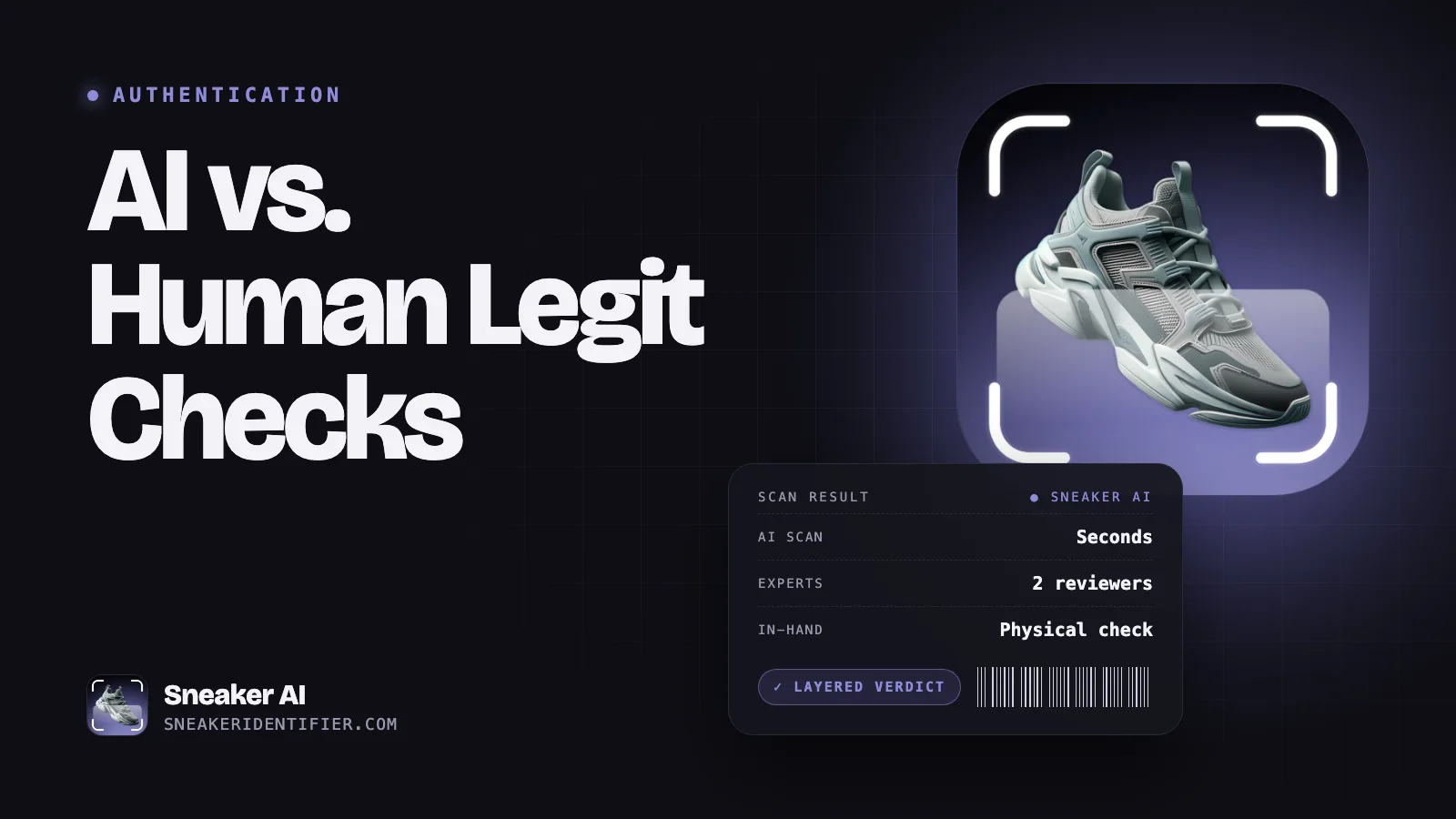
Sneaker authentication used to mean posting blurry photos on a forum and hoping someone knowledgeable replied. Today you have real options: AI legit check apps that return a verdict in seconds, professional human authenticators who review your photos, and platforms that physically inspect pairs before they ship.
Each approach has real strengths and real blind spots. Knowing the difference helps you pick the right level of checking for each pair, so you don't overpay for a check on a cheap general release or under-check a grail.
Quick answer: AI authentication is fast, consistent, and inexpensive, and it catches most fakes when the photos are clear. Human experts are better at edge cases, unusual releases, and judgment calls. In-hand authentication (physically inspecting the pair) is the most thorough. For everyday pairs, an AI scan is often enough. For expensive or unusual pairs, combine AI with an expert review, and always buy with buyer protection.
How AI Sneaker Authentication Works
AI legit checks use computer vision models trained on large collections of images of authentic and counterfeit sneakers. When you submit photos, the model:
- Identifies the model and colorway so it knows what the shoe should look like
- Examines specific regions such as stitching, logos, fonts on tags, panel shapes, and proportions
- Compares those details against patterns learned from authentic and fake examples
- Returns a verdict, usually with a confidence level
Most AI legit check apps ask for specific angles (side profile, heel, tongue tag, size tag, insole, sole, and box label) because each angle shows details the model has been trained to evaluate.
What AI Does Well
- Speed: Results in seconds, any time of day. That matters when a good deal won't wait.
- Consistency: An AI model doesn't get tired, distracted, or rushed. The same photos get the same evaluation.
- Fine measurement: Small differences in logo proportions, font weight, letter spacing, and shape geometry are hard to judge by eye but measurable for a model.
- Cost: AI checks are inexpensive enough to run on every secondhand pair, not just grails.
- Coverage of popular models: For heavily produced (and heavily faked) shoes like Jordan 1s, Jordan 4s, Dunks, and Air Force 1s, there's a large amount of reference data to learn from.
Where AI Falls Short
Being honest about the limits is what makes AI useful rather than dangerous:
- It only sees the photos. AI can't feel leather, flex a toe box, smell glue, or weigh the shoe.
- Photo quality matters. Blurry, dark, filtered, or partial photos reduce accuracy. Garbage in, garbage out.
- New fakes and rare pairs: A brand-new counterfeit batch, or a rare release with few reference images (samples, vintage pairs, regional exclusives), can be harder to judge.
- The photo-swap problem: If a seller sends photos of an authentic pair but ships you a fake, no photo-based check can catch that. The verdict applies to the pair in the photos, which is why tagged photos and buyer protection matter.
How Human Legit Checks Work
Professional authenticators are experienced specialists who compare a pair against their knowledge and reference libraries of authentic examples. Many app-based services work from your photos. Some services and platforms inspect the shoes in person.
Some services use multiple independent experts on each pair, and a verdict requires agreement. That reduces the risk of a single reviewer's mistake.
What Human Experts Do Well
- Judgment on edge cases: Experts know that authentic pairs vary between factories and production runs, and can tell normal variation from a counterfeit tell.
- Release-specific knowledge: Details that differ between retros, regional versions, and special editions.
- Unusual items: Samples, player editions, older pairs, and limited releases with little public reference material.
- Explaining the verdict: A good authenticator can point to exactly what looks wrong.
Where Human Experts Fall Short
- Speed and cost: Slower and more expensive than AI, so harder to justify for every pair
- Consistency: Humans get tired and can disagree, which is why multi-expert reviews exist
- Photo limits: A remote human reviewer is constrained by photo quality, just like AI
In-Hand Authentication
Physically inspecting a pair is the most thorough form of authentication. An in-hand authenticator can check materials, construction, weight, smell, and UV reactions, and compare the pair side by side with known retail examples.
Some resale platforms physically inspect pairs before shipping them to buyers, and consignment stores authenticate what they accept. In-hand checks are the gold standard for very expensive or unusual pairs. Still, no process (AI, human, or in-hand) is perfect, which is why buyer protection matters at every level.
The Super-Fake Problem
"Super-fakes" (sometimes marketed as "UA" or "1:1" replicas) are top-tier counterfeits built specifically to pass casual inspection. Their makers:
- Fix the obvious tells that older fakes were known for, like misspellings, wrong colors, and sloppy stitching
- Use closer materials that feel convincing to most buyers
- Copy real tags and boxes, sometimes including real style codes and UPC barcodes
- Ship with real or high-quality boxes to complete the illusion
That's why a quick glance, a barcode scan, or a single checkpoint is no longer enough. But super-fakes still get caught, because perfect replication is expensive:
- Shape and proportions: Molds and lasts are costly to perfect, so silhouettes are often slightly off
- Fine typography: Tag fonts, letter spacing, and print quality are hard to match exactly
- Material texture under magnification: Close-up photos reveal differences in grain, nap, and finish
- UV reactions: Counterfeit factories may use glues, threads, or guide markings that glow differently
- Accumulated deviations: Each detail might be "almost right," but a fake rarely gets every detail right at once
Layered authentication works best. AI measures fine details consistently, experienced humans apply judgment to borderline cases, and in-hand checks add the senses photos can't capture.
AI vs. Human vs. In-Hand: Side by Side
| AI legit check | Human expert (photo-based) | In-hand authentication | |
|---|---|---|---|
| Speed | Seconds | Minutes to hours | Days, including shipping |
| Cost | Low | Moderate | Highest |
| Consistency | Very high | Varies by reviewer | Varies by authenticator |
| Edge cases and rare pairs | Weaker | Strong | Strongest |
| Touch, smell, and weight | No | No | Yes |
| Best for | Everyday secondhand pairs; first-pass screening | Valuable pairs; borderline AI results; selling with proof | Grails, vintage, samples, very high-value pairs |
Which Level of Authentication Do You Need?
A practical rule of thumb:
- Bought new from Nike, Adidas, or an authorized retailer: No check needed. Keep your receipt.
- Secondhand everyday pairs: Run an AI scan. If it's clean and the seller checks out, you're in good shape.
- Valuable pairs, collaborations, or a borderline AI result: Add an expert human review, ideally from multiple independent authenticators, and get a certificate.
- Grails, vintage pairs, samples, or very high-value pairs: Consider in-hand authentication by a specialist.
- Selling: A certificate of authenticity reassures buyers and helps your listing stand out, especially on peer-to-peer marketplaces.
How to Photograph Sneakers for a Legit Check
Whether a human or an AI reviews your pair, better photos mean better verdicts. Shoot:
- Outer side profile of each shoe
- Inner side profile
- Heel, straight on
- Toe box from above
- Tongue tag (front)
- Size tag, sharp enough to read every character
- Insole, plus the stitching underneath it if it's removable
- Outsole
- Box label
- Close-ups of logos and stitching
Use bright, even daylight, skip filters, keep the whole shoe in frame for profile shots, and make sure every photo is in focus. If you're buying, ask the seller for tagged photos with a handwritten note showing their name and today's date, so you know the photos show the pair they actually have.
Frequently Asked Questions About AI and Human Legit Checks
Is AI sneaker authentication accurate?
For popular models photographed clearly from the right angles, AI authentication is a strong first line of defense. Accuracy drops with poor photos and with rare pairs that have little reference data, so use expert review for expensive or unusual pairs.
Can AI detect super-fakes?
AI can catch many super-fakes because it measures fine details (proportions, fonts, spacing) consistently. The most sophisticated fakes are best handled with a layered approach: AI plus experienced human review, and in-hand inspection for very valuable pairs.
Is a human legit check worth paying for?
For valuable pairs, yes. The cost of an expert check is small compared with the cost of buying a fake grail or losing a buyer's trust. For cheap general releases, an AI scan is usually enough.
What is a sneaker certificate of authenticity?
It's a record, often a shareable digital certificate, showing that a pair passed an authentication check. Sellers use it to reassure buyers. It's only as trustworthy as the process behind it, so look for services with expert review.
Can I legit check sneakers using the seller's photos?
Yes, but only the photos are being checked. Ask for tagged photos and a full set of angles, and pay with a method that offers buyer protection in case the pair that arrives differs from the photos.
Do resale platforms ever let fakes through?
No authentication process is perfect, and every major platform has faced occasional complaints. Platform authentication greatly reduces risk, but keep your documentation, check pairs when they arrive, and know the platform's return and dispute process.
AI and human authentication aren't rivals. They're layers. Use AI for speed and consistency on every secondhand pair, bring in human experts when the stakes or the uncertainty go up, and lean on in-hand checks for grails. For model-specific checks, see our guides to Nike Dunks, Air Force 1s, Jordan 4s, and Adidas, or start with our complete sneaker authentication guide.
Get Both: AI Speed and Expert Certainty
Run an instant AI legit check on any pair, then upgrade to a review by two professional authenticators with a shareable Certificate of Authenticity.